


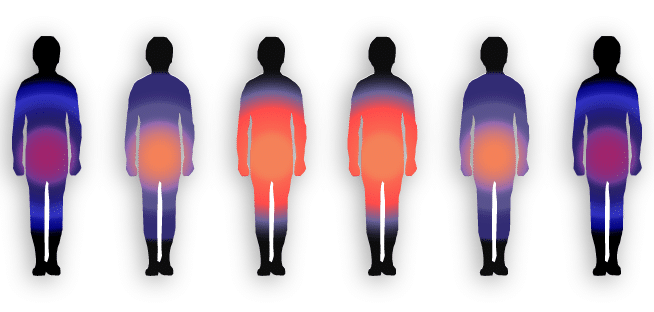
How are you feeling today? Have you taken on the day or is it taking on you? It is a scientific fact that your personal mood drives communication performance. The latest studies in physiology and neuroscience demonstrate that our emotions are heavily driven by signals in our bodies and brains. Accomplished British author and academic Dr. Alan Watkins has studied this phenomenon amongst leading CEOs for over 15 years.
These signals have substantial influence on our reactions to everyday situations. Historically in humans these manifest in fight or flight type responses. In modern, safer and more complex times the human reactions are far subtler. So subtle that most of the time we have no idea these influences are at play. We simply think we can’t do something, don’t feel in the mood or conversely feel we can take on the world. In fact the main reason why we adopt certain behaviors in certain situations is not because we have chosen to, but rather our brains and bodies have signaled a type of response. These physiological signals drive our emotions which in turn drive our feelings and thoughts, then our behavior and finally our performance. It is like a subconscious chain of events building up to a particular situational response such as anxiety, happiness, anger, or euphoria.
So what does this mean for our daily performance in terms of how we interact with others? If our physiology and our emotions are driving our behavior this will substantially impact our influence on those around us. We will be radiating our ‘bad day’ or ‘good day’ onto others and they will respond accordingly. Further recent studies in the US and Europe suggest that we are inherently social beings and respond to the social influences around us to such a degree that it can impact our wellbeing. Our social communication style will determine whether the day will remain bad, turn good or vice versa.
So, how can we tune in to some of the deeper influences on our mood and emotions? How can we utilize this intelligence to enhance our communication performance for positive impact?
Five ways to get in touch with your inner self and in doing so nail your human interactions
1. Go deep
Dr. Watkins points out that most of the time we look to our behavior in a situation as the reason for good or poor performance. This is especially true of communication. How often have you thought: ‘I should not have said that’ or ‘I could have dealt with that better’? By looking at your behavior you are only scratching the surface of your communication performance. Consider very carefully what emotions are at play in your communication style. It is these that drive the behavior. By getting under your emotional skin you will get a much clearer picture of your own performance influencers.
2. Evaluate
Deconstruct situations where you had a ‘winning’ communication performance. What emotions were you feeling that day? How did your body react and how did those around you react? Were you anxious or confident? What physiological reactions did your body have at the time? Stomach churning anxiety moments likely led to poor performance or blanking out. Other bodily reactions would have led to clarity and focus. We have all experienced both. What was the difference and why?
3. Experiment
Some of the best scientists, celebrity chefs and innovators are highly successful because they keep trying different approaches to explore cause and effect. Once you have been able to isolate those physiological variables that are influencing your emotions try out some scenarios. Try running a meeting with a particular ‘mood’ on. See the reactions of those around you and take note. Then try again with a different style. You will be amazed at the difference and will be able to identify winning approaches.
4. Observe
As well as going deep and understanding your own physiological response to certain situations, start looking at others. Become an amateur anthropologist. People watching is a favorite pastime for most. Engage in this activity with scientific purpose. What can you tell from the observed behaviors of people that lead you to understand more about the physiology and emotions that are driving those behaviors? How does it compare to your own responses?
5. Reflect
At the end of any given day find a space and have 15 minutes of solitude. The Dalai Llama recommends we do this every day. In this time consider your mood for that day and the emotional signals you have communicated to others. In doing so try very hard to dissect the behavior from the emotion. It’s like a communication debrief. What have you learned and what can you improve? Remember it’s not about control it’s about understanding.
By the way, none of the above is easy. If it were we would all be emotionally tuned and living in a harmonious utopian world. It takes time and focus but it will help you identify with clarity the personal signals that are unique to you and your emotions. This will lead the way on how to be a high performance communicator for success and wellbeing.
2 Comments
Leave your reply.